
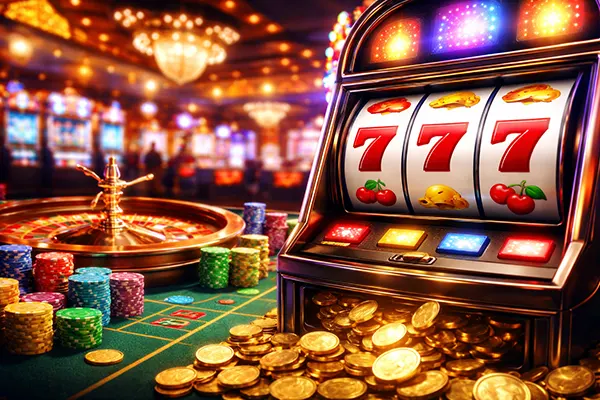
Why People Believe in “Lucky” Slot Machines and “Hot” Tables
In both land-based casinos and online environments, many players are convinced that certain machines or tables can be “lucky” at specific moments. This belief persists despite clear mathematical evidence that outcomes are random and independent. Understanding why these ideas remain so widespread requires looking beyond game mechanics and focusing on human psychology, behavioural patterns, and how the gambling environment is designed.
The psychology behind perceived luck and patterns
Human brains are naturally wired to detect patterns, even where none exist. This tendency, known as pattern recognition bias, evolved as a survival mechanism but often leads to incorrect conclusions in games of chance. When a player observes several wins in a short period, it is easy to assume that a machine or table has entered a “lucky phase,” even though each result is statistically independent.
Another important factor is confirmation bias. Players tend to remember moments that support their beliefs and ignore those that contradict them. For example, if someone believes a specific slot machine pays out more often, they will recall occasional wins but overlook longer losing streaks. Over time, this selective memory reinforces the illusion of a “hot” machine.
Emotional involvement also plays a role. Wins trigger dopamine release, creating a strong emotional imprint. When a win happens on a particular machine or table, the player may associate that location with positive outcomes. This emotional link can be stronger than rational understanding, especially in environments designed to heighten excitement.
Why randomness is difficult to accept
Randomness, especially in gambling, does not feel intuitive. People expect outcomes to “balance out” in the short term, which leads to the gambler’s fallacy — the belief that after a series of losses, a win is due. In reality, each spin or hand is independent, governed by random number generators or physical probability.
Short-term variance can be misleading. A machine might produce several wins close together purely by chance, creating the impression of a streak. Without understanding statistical distribution, players may interpret this as evidence of a predictable pattern rather than normal randomness.
Complex game design can further obscure how outcomes work. Many players are not familiar with concepts such as RTP (Return to Player) or volatility. Without this knowledge, it becomes easier to rely on intuition or anecdotal experience rather than data.
The role of casino environments and design
Casinos are carefully structured to encourage prolonged engagement, and this includes subtle cues that influence perception. In physical venues, the placement of machines, lighting, and sound effects all contribute to the impression that wins are happening frequently. Seeing others win can create a sense that certain areas are “active” or more favourable.
Online interfaces replicate similar effects through visual and auditory feedback. Celebratory animations, near-miss outcomes, and frequent small wins can create the impression of ongoing success, even when overall losses occur. These elements can reinforce the belief that a machine is performing well.
Another important factor is visibility. Players tend to gather around machines that have recently paid out, assuming that success might continue. In reality, modern systems do not track previous outcomes in a way that affects future spins, but the social behaviour around these machines strengthens the perception of “hot spots.”
How near-misses influence player beliefs
Near-miss outcomes — for example, when two jackpot symbols appear and the third just misses — are particularly powerful. Studies show that these events activate similar brain responses to actual wins. As a result, players may feel that they are “close” to winning, reinforcing the idea that persistence will pay off.
This effect can create a false sense of progress. Even though the outcome is a loss, the visual similarity to a win makes it feel meaningful. Over time, players may believe that a machine is about to “hit,” despite no underlying mechanism supporting that assumption.
Design elements such as spinning reels slowing down or highlighting near-winning combinations are not accidental. They are intended to enhance engagement, but they also contribute to misunderstandings about how outcomes are generated.

Common myths about “lucky” machines and tables
One of the most persistent myths is that a machine that has not paid out for a while is “due” for a win. In reality, modern slot machines use random number generators that operate continuously, meaning each spin is independent of previous results. There is no memory or cycle that ensures a payout after a losing streak.
Another widespread belief is that certain times of day affect outcomes. Some players claim that machines are more generous during quieter hours or after maintenance. However, licensed operators use regulated systems where payout percentages are fixed over the long term and cannot be adjusted dynamically in this way.
Table games are also subject to similar misconceptions. For example, in roulette, players may believe that a sequence of red results makes black more likely. This is incorrect, as each spin of the wheel has the same probability regardless of previous outcomes.
What actually determines outcomes in 2026
As of 2026, regulated online and land-based casinos rely on certified random number generators and strict compliance standards. Independent testing agencies audit these systems to ensure fairness and unpredictability. This means that no strategy based on “timing” or “machine selection” can alter the fundamental probabilities.
Return to Player percentages provide a long-term expectation of payouts, but they do not guarantee short-term results. A player might experience significant variation during a single session, which can be misinterpreted as evidence of patterns or trends.
Understanding these mechanics helps players make more informed decisions. Rather than searching for “lucky” machines or tables, it is more practical to focus on bankroll management, game rules, and realistic expectations about variance.